.avif)


Oda: The first electric Luffe
When Peter and Annette Hartvig Bohé ordered a brand new Luffe 3.6+ from the Danish yard Luffe Yachts, one thing was decided from the very beginning: the boat would have an electric motor.
The result is Oda, the first electric boat ever built by Luffe Yachts, equipped with the Searine M360° and seven Searine B48 battery modules.
“My wife and I were very determined that we would like to have an electric motor on board.”
For Peter, choosing electric propulsion was not simply about replacing a diesel engine with an electric motor. The complete system had to fit naturally into the boat and work with the characteristics of a fast, performance oriented cruiser like the Luffe 3.6+.
Luffe and Searine: working together from the start
As Luffe’s first electric boat, Oda was not a standard installation. Luffe Yachts and Searine worked together from the very beginning of the project to find a solution where the motor and batteries would be properly integrated into the boat rather than added as an afterthought.
For Peter, that cooperation is exactly what shows in the finished boat.
“What has astonished us is how well integrated the motor and the batteries are in the boat.”
Building the boat around electric propulsion from the start also created the opportunity to think differently about where the components should be placed and how their weight could become part of the overall design of the boat.
Battery weight where it helps the sailing
Peter has a background in yacht racing, and for him the batteries were not just a question of range. He wanted their weight to work for the boat, not against it.
“I’m a racer by heart, and I would very much like that we could use the weight of the batteries to improve the sailing abilities of the boat, and we have achieved that.”
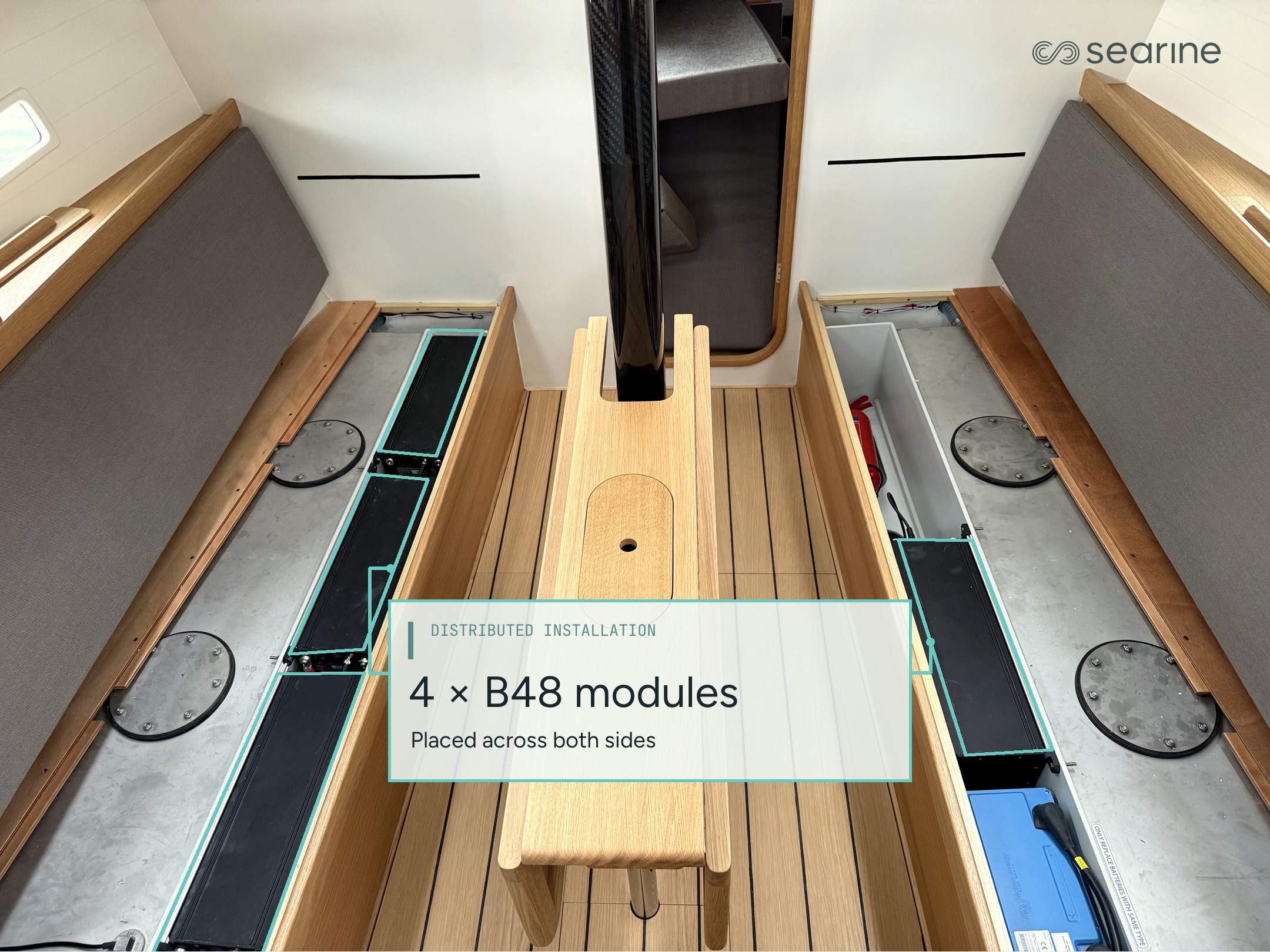
On Oda, the seven B48 battery modules sit centred right over the keel, underneath the berths. This keeps the weight low and central while making efficient use of space that would otherwise be difficult to utilise.
“They are out of the way, no one can see them, and they just fit perfectly into the boat.”
It means that although Oda carries the battery capacity needed for longer trips under motor, the installation does not compromise the space and layout on board.
Nine hours under motor, half the battery left
The other surprise was the range. On a trip from the yard to a Danish island, Oda motored for nine hours and used around 50 percent of the available battery capacity.
For Peter, it was an important first real world experience with the new boat and a chance to see how the electric system would perform outside the calculations and estimates made during the build.
After nine hours under motor, there was still plenty of energy left in the batteries.
“No problem. No reason for range anxiety.”
And when the sails go up, the propulsion system can change roles. With the M360° in Hydrogeneration Mode, the rotation of the propeller while sailing can be used to generate electricity and put energy back into the batteries.
Built electric from the beginning
Oda shows what becomes possible when electric propulsion is considered from the beginning of a new boat project.
The motor, batteries and boat have been designed to work together. The batteries are positioned where their weight makes sense for the sailing characteristics, the installation is largely hidden away, and the first longer trips have shown Peter and Annette that electric propulsion can comfortably fit the way they want to use their boat.
For Peter and Annette, the decision was made before the boat was even built: Oda was going to be electric.
Now that she is on the water, they can finally see the result.
Boat Specifications
Last trip data